Why strategies fail (& how to fix them)
70% – 90% of ALL strategies fail. Learn why and what you can do to fix them.
Clear thinking. No fluff. Just strategy that works.
Why strategies fail
Note that the images on this page are all of public, private and not-for-profit sector strategies that failed. You can find out more about them in Craig Lawrence’s best-selling book The Quick Guide to Effective Strategy.
Research suggests that between 70% – 90% of all strategies fail (in both the public and private sector). There are three main reasons why:
- Poor development.
- Poor implementation.
- Very significant and unexpected changes in the operating environment.
This page explores the common strategy mistakes people make when developing a strategy (in Part 1) and then implementing it (in Part 2) so you can try to avoid making them.
Trying to predict how your operating environment is likely to change over the lifetime of your strategy is critical to its development. This is because it’s the only way you can identify the likely future opportunities your strategy might be able to exploit to help achieve its vision, as well as the threats it will most likely need to address.
Strategies that are not built on assumptions about how the future is likely to unfold and are not designed to take account of the opportunities and threats it is likely to create will almost certainly fail. But futures analysis is not that easy, which is why it’s so often ignored. Part 3 of this page therefore includes one of our short strategy films that explores the challenges of predicting the future and suggests some tools and techniques that can help you do it.

Part 1: Common strategy mistakes during development
The most effective strategies have eight key characteristics in common. They also pass the so-called ‘Five Tests of Strategy’ and have a logical structure. When you develop your strategy – or adapt it if it’s failing – try to ensure that it has the eight characteristics, that it passes the five tests and that it has a logical structure.
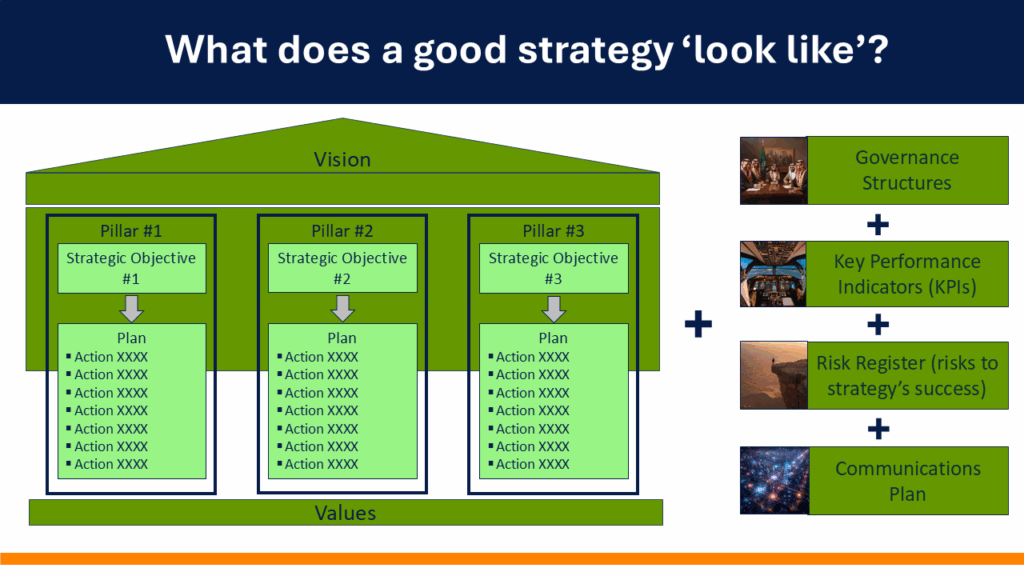
The following sections cover each of these aspects in turn, using a Strategy House to illustrate what an effective strategy ‘looks like.’
The 8 characteristics of effective strategy

- Clarity of purpose: it’s clear why a strategy is needed and what its desired endstate is.
- Designed for uncertainty: they are designed to operate in Volatile, Uncertain, Complex & Ambiguous (VUCA) environments (because the future is likely to be more turbulent than the present).
- High level: they operate at a high level, determining the direction of travel of an organisation.
- Address ‘wicked’ problems: they are designed to address ‘wicked’ problems, where neither the problem nor the solution is easily identified.
- Account for all stakeholders: they seek to change the behaviours of stakeholders to create favourable conditions.
- Are highly innovative: they are highly innovative, with a central ‘big idea’ or ‘guiding policy’ that ‘magnifies’ their effect and enhances their resilience.
- Provide a ‘theory of success’: this explains how the desired endstate is to be achieved, rather than just a general approach.
- Are adaptable: they are highly adaptable (so the strategy can be modified as the situation changes or when it becomes apparent that assumptions underpinning the strategy’s development were flawed).
The Five Tests of Strategy
- Is the strategy suitable? (Is it likely to achieve the strategic objectives, and hence the vision? Does it apply our strengths to exploit opportunities and protect or address our weaknesses? Is it appropriate to the circumstances?)
- Is the strategy feasible? (Can it be done?)
- Is the strategy acceptable? (Politically, economically, socially, technologically, legally and environmentally?)
- Is the strategy sustainable? (Do we have the resources to sustain it? Is our organisation structured to support it/aligned behind it? Do we have the will to see it through, particularly if things don’t go well to start with?)
- Is the strategy adaptable? (Does the strategy have a central ‘big idea’ to provide resilience and act as a touchstone when things don’t go as planned? Is the strategy’s success based on causal relationships that we don’t really understand? Are aspects of the strategy time or condition dependent? Can we adapt it if the risks we have identified manifest or the situation changes unexpectedly and how easily can this be done?)
A logical structure for a strategy
- Introduction: explains why the strategy is necessary; gives people a reason to care and a reason to act in support of the strategy.
- Vision: a simple statement that sets out exactly what the strategy is trying to achieve.
- Values: an explanation of the core values underpinning the strategy.
- Environment: a description of the operating environment and the opportunities that could be exploited to achieve the vision, as well as the threats/obstacles that will need to be overcome.
- Strategic Objectives (‘ends’): realistic ‘ends’ which, if achieved, would collectively realise the vision. Ideally underpinned by a ‘Big Idea’ that acts as a ‘touchstone’ when the situation changes (which it will), enhancing the strategy’s resilience.
- Actions and Resources (‘ways’ and ‘means’): The actions that will achieve the strategic objectives, providing the ‘theory of success’ for how the vision will be achieved.
- Risks: areas of risk which remain and how they will be managed.
- Performance Metrics: metrics that track whether the strategy is being implemented as intended and whether it’s having the desired effect. Effective metrics (call them Key Performance Indicators (KPIs) if you wish) should trigger adaptation before the strategy fails.
- Governance: clear lines of responsibility for implementing the strategy and monitoring its performance (named individuals, not committees!).
In 2008, the UK Government had to inject £45.5 billion to stop the Royal Bank of Scotland (RBS) from failing. In its report into why the bank failed, the Financial Services Authority (FSA) noted that: ‘Given the scale of RBS’ ambitions for growth, in particular during 2006 and into 2007, it is reasonable to expect the Board to have assured itself that the growth strategy was accompanied by a very high degree of attention to the associated risks. In retrospect, this was not clearly and demonstrably the case.’
An illustrative structure (the Strategy House)
An effective strategy should have all the component parts shown in the diagram (which is just a visual way of illustrating the logical structure described above). If you can’t explain your strategy using a similar diagram, then it’s highly likely you’re missing something!
Note that explaining your strategy in the format of a Strategy House is an excellent way of communicating all the key parts of the strategy on a single page, though don’t be constrained to just 3 strategic objectives as anywhere between 3 and 5 is fine.
Part 2: Common strategy mistakes during implementation
There are two key questions that we need to ask before starting to implement a strategy:
- Question 1: is the strategy ready to be implemented?
- Question 2: are we ready to implement the strategy?
The following sections explore each question in turn. The final section includes a short strategy film (7 mins) on understanding alternative futures because if your strategy isn’t based on assumptions about how the future is most likely to unfold, it’s almost certain that it will fail.
Question 1: is the strategy ready to be implemented?
If our strategy has the eight characteristics mentioned above, has passed the five tests and follows the logical structure described, there are then five straightforward questions we can ask ourselves to check whether the strategy is ready to be implemented:
- Actions: do all the actions to achieve each of the strategic objectives have a clear ‘owner’ and have these ‘owners’ agreed they can complete their actions in the required timeframe? Are the actions resourced (people, money, time etc) and synchronised?
- Risks: have we identified the risks to the strategy’s success and have we done what we can to reduce the likelihood that these risks will materialise and their impact if they do? As well as negative risks that might materialise, have we also identified positive risks (opportunities)?
- Performance Metrics: are metrics and Key Performance Indicators (KPIs) in place to tell us whether the strategy is working? Are we clear who is tracking these and reporting them?
- Wider Environment: have we prepared the wider environment for the strategy’s launch (strategic narrative and communications plan targeting specific stakeholders)?
- Final Road Test: can we do a final test of the strategy before we launch it (ROC Drill, wargame, Red Team, premortem etc) and adapt it if necessary?
As this quote from the Chilcot Report suggests, even Governments engaged in costly endeavours (in both blood and treasure) get it wrong: ‘Crucially, UK strategies tended to focus on describing the desired end state rather than how it would be reached. On none of the 20 occasions when UK strategy was reconsidered was a robust plan for implementation produced.’ In sum, the strategy was not ready to be implemented.
Question 2: are we ready to implement the strategy?
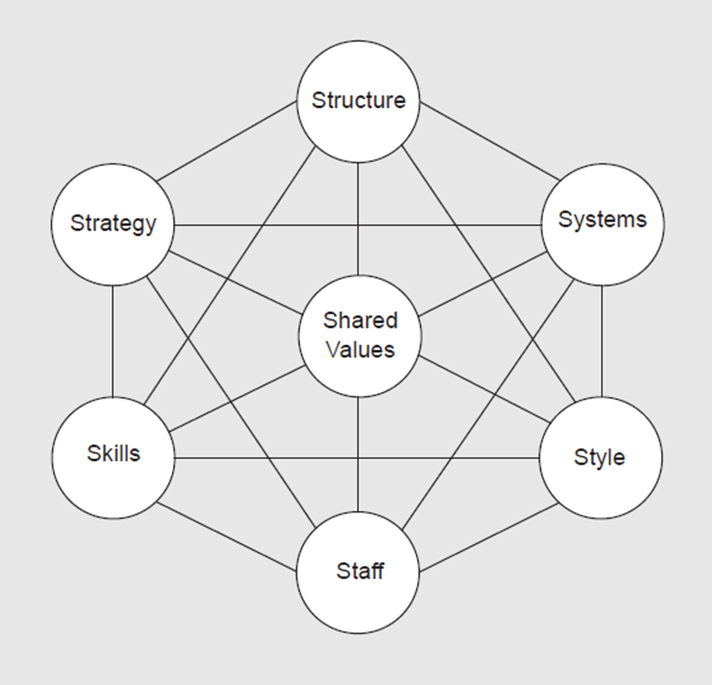
If we have considered Question 1 and answered the five subordinate questions, the next step is to ensure that the implementing organisation is aligned behind the strategy before its launch. One of the most effective ways of doing this is to apply the McKinsey 7-S Framework, where each ‘S’ corresponds to a key aspect of the organisation. You can find out how to apply this in Craig Lawrence’s best-selling book The Quick Guide to Effective Strategy but the following questions under the six ‘S’s that need to be aligned behind the strategy ‘S’ give you an idea of how you can approach this:
- Structure: Are the organisational structures in place to oversee the implementation and continual adaptation of the strategy? Who ‘owns’ the strategy? Are the governance structures clear?
- Systems: Are the organisation’s systems (finance, HR, communications etc) aligned with the strategy and prepared to support it, both initially and throughout its lifecycle? Is a system in place to monitor the strategy’s performance and identify when it needs to be adapted?
- Style (aka leadership): Is the person leading the strategy’s implementation likely to be effective in this role? If not, do we need to upskill them or consider replacing them? Are the different teams involved in implementing the strategy likely to be cooperative or competitive? If the latter, how do we address this?
- Staff: Is there a need for a dedicated team (full or part time) to oversee the strategy’s implementation? If so, who should be in it and can it be formed up in time?
- Skills: Do the people in the team implementing and then supporting the strategy have the skills they need to do what is required? If not, do we have a plan to close the skills gap?
- Shared values (aka culture): Do the strategy’s values accord with the organisation’s values and culture? If not, is this likely to cause problems? If so, how will we resolve them?
Part 3: Understanding alternative futures
Watch just the first few minutes – we guarantee it will change how you think about the future (and strategy). Note that if you’re using a VPN, it’s likely that the video will not play unless you log in to YouTube.

In the first episode in his ‘Quick Strategy’ series, Craig Lawrence explained how the most effective strategies seize emerging opportunities and overcome future challenges to achieve a desired endstate. But to build such strategies, we must first ask: what kind of future might we be heading into and what opportunities and threats are likely to unfold? In this short strategy film, Craig explores the concept of alternative futures – possible scenarios that could shape the strategic landscape ahead. By understanding these potential futures, leaders can develop more resilient, adaptable and forward-looking strategies.